Three small islands, three different trips
The three have little in common except that few tourists reach them. Maio, a short hop from Santiago, is flat and sandy like Boa Vista but without the big resorts. São Nicolau, between São Vicente and Sal, is mountainous, with quiet trails and a fishing town. Brava, next to Fogo, is green and steep and can only be reached by sea.
None of them has large hotels, nightlife or a long menu of excursions, and on all three you depend on a limited number of flights or ferries. Read ferries and flights between the islands before you plan, and do not schedule a small island for the last days before your flight home.
Maio: empty beaches and turtles
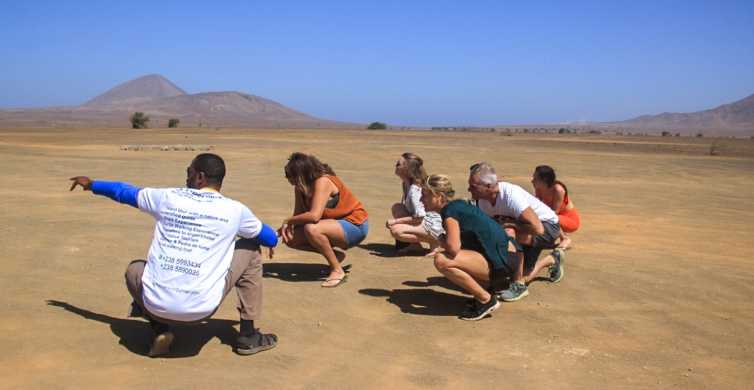
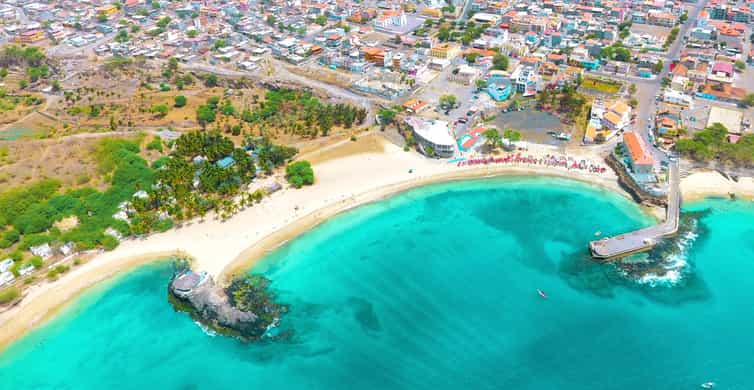
Maio is low and dry, with long beaches of pale sand, dunes, salt pans, a large planted forest around Calheta in the north and a handful of villages. The capital, Vila do Maio, was long known as Porto Inglês, after the English ships that came to load salt from the pans beside the town. It has a large parish church, a small fort and a lighthouse, and a beach right in front of the houses. The tourism institute lists more than 20 beaches on the island, among them Praia Real, Praia da Lagoa and Praia do Morro, which is part of a nature reserve.
Loggerhead turtles nest on Maio's beaches in summer; the tourism institute puts the number at around 3,000 females a year and says night visits should only be made with a guide or biologist. Follow the same rules as on Boa Vista: no torches or flash, keep your distance and never touch the turtles or hatchlings (turtle watching).
CVsky flies from Praia to Maio in about ten minutes, and CV Interilhas ferries cross from Praia in about two hours a few times a week. The airline lists Maio among the aerodromes most affected by dust haze and strong wind, so cancellations happen. Hotels in Maio are small hotels, apartments and guesthouses, mostly in and around Vila do Maio, with few restaurants; hire a car with a driver or a bicycle to reach the beaches. Maio suits people who want empty sand and village life and are happy with very little else to do.
São Nicolau: mountains, dragon trees and Tarrafal
São Nicolau is the walkers' alternative to Santo Antão. Its highest point, Monte Gordo, rises to 1,312 m and is protected as a natural park, with trails through the green upper valleys around Cachaço and Fajã, where dragon trees grow on the slopes. On a clear day the summit looks across much of the archipelago, but fog often covers it, so go early. The old capital, Ribeira Brava, sits in a narrow valley with colonial houses, the main church and the former seminary that made the town an important centre of education.
On the dry west coast, Tarrafal is a fishing town with a tuna cannery, black-sand beaches and boats for big-game fishing for blue marlin; snorkelling and diving are possible nearby. Further along the coast, Praia Branca and Praia do Barril are among the island's best-known beaches. Ask your guesthouse about local guides for the longer hikes (hiking in Cape Verde).
Preguiça aerodrome, close to Ribeira Brava, has CVsky flights; check which islands it is linked with in your season, as routes are thin. By sea, CV Interilhas' round line usually calls twice a week on its way between São Vicente, about five hours away, and Sal. Hotels in São Nicolau are small hotels and guesthouses in Ribeira Brava and Tarrafal. It suits hikers, anglers and travellers who like small towns.
Brava, Cape Verde's smallest inhabited island
Brava covers only 67 km² but rises to 976 m at Monte Fontainhas, and it is known for green valleys and flowers, often wrapped in mist. The capital, Nova Sintra, lies inland in the hills, with gardens around its central square, a market and the house museum of the poet Eugénio Tavares, whose mornas are sung all over the islands. Ferries arrive at Furna, a fishing harbour in a bay below; from there a minibus or taxi climbs up the winding road to Nova Sintra. On the west coast, Fajã d'Água is a sheltered bay with natural pools beneath steep cliffs.
Brava has a long history of emigration to New England in the United States, which began with the 19th-century whaling ships, and many families have relatives there. The walking is excellent: one path drops from Nossa Senhora do Monte to Fajã d'Água, and another climbs from Mato Grande to Monte Fontainhas, the island's highest peak.
There is no airport in service. CV Interilhas ferries from Fogo reach Furna in under an hour, on a line that starts in Praia, and crossings can be rough or cancelled in bad weather. Hotels in Brava are a handful of small hotels and guesthouses, mainly in Nova Sintra and at Fajã d'Água, and meals are often served in private homes. Brava suits hikers, travellers with time to spare and visitors tracing family roots.
Which small island, and how many days
Choose Maio for beaches and turtles, São Nicolau for walking and fishing, and Brava for scenery and peace. Each fits naturally with a larger neighbour: Maio with Santiago, Brava with Fogo, and São Nicolau with São Vicente or Sal on the ferry's round line. Allow three or four nights on each, plus a spare day for delayed connections.
Bring enough escudos: there are banks in the main towns, but cash machines are few and small guesthouses often do not take cards (currency and prices). For other places to stay across the islands, see where to stay, and for the best months, the best time to visit.