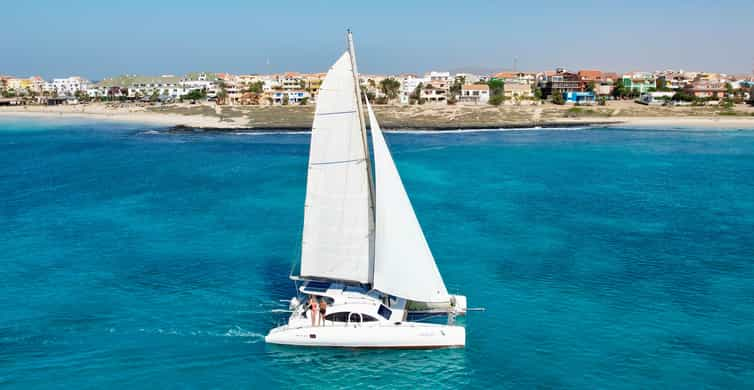
Sal island Cape Verde weather at a glance
Sal lies in the tropics, off the coast of Senegal, but the cool Canary Current and the north-east trade winds keep it from ever getting very hot. It is also flat and low, so clouds pass over without dropping much rain. The result is a desert climate with a narrow range: in Santa Maria, average highs move only between 24 °C and 29 °C through the year, and nights between 20 °C and 25 °C.
The figures on this page are averages for Santa Maria from ERA5 reanalysis data for 2015-2024, with sea temperatures for 2022-2025. They describe the typical month; individual days can be a degree or two warmer or cooler.
Temperature in Sal through the year
December to May is the mild season. Highs are 25 °C in January, 24 °C in February and March and 25 °C in April and May, with nights around 20-22 °C. With the wind it feels pleasant rather than hot, and a long-sleeved top is useful after sunset. These are the months most winter-sun visitors from the UK and northern Europe choose; see January or March for details.
June to November is the warm season. Highs rise to 26 °C in June and 27 °C in July and reach 29 °C from August to October, when nights stay at 24-25 °C and the air is noticeably more humid. November cools slightly to 28 °C and December to 26 °C. Even in the hottest months the breeze keeps the heat bearable, but the sun is strong all year at this latitude, so use high-factor sun cream and a hat from the first day.
Sal in winter: December, January and February
Winter is Sal's high season. In December Santa Maria averages about 26 °C by day and 22 °C at night, with the sea at 25 °C; in January the figures are 25 °C and 20 °C, with a sea of 24 °C; and in February 24 °C and 20 °C, with the sea at 23 °C. Rain is close to zero in December and January, and February's average of about 10 mm usually means a passing shower or two.
What defines the season is the wind and the light. The trade winds blow almost every day, evenings on a terrace call for a long-sleeved top, and spells of Saharan haze can dim the sun for a day or two. The details of each month are in December, January and February; the island next door, with almost identical figures, has its own page, Boa Vista weather.
Sea temperature
The Atlantic around Sal is coolest in late winter: 23 °C in February, 22 °C in March and 23 °C in April, which feels fresh on a windy day. It warms to 24 °C in May and June, 26 °C in July and 27 °C in August, and peaks at 28 °C in September and October. It is still 26 °C in November, 25 °C in December and 24 °C in January.
For long swims and snorkelling without a wetsuit, July to December is the most comfortable period.
Wind
Sal is windy for most of the year. The trade winds blow hardest roughly from December to May, often for days without a break, and ease off from about August to October, when calm spells are more common. That is why the winter months are the main season for kitesurfing and windsurfing at Kite Beach and Ponta Preta; see kitesurf, windsurf and surf.
For beach holidays the wind is a mixed blessing. It makes the heat comfortable, but on exposed beaches it blows sand around. The bay of Santa Maria faces south and is the most sheltered part of the coast, while the east coast and the north are much rougher.
Dust haze: the bruma seca
Between roughly December and February, winds from the Sahara can carry fine dust over the islands. Locals call it bruma seca, dry haze. It turns the sky a milky white and the sun hazy for one or several days, lowers visibility and can make the air feel drier and cooler. If you have asthma or another breathing condition, keep your medication to hand.
The haze can delay or cancel inter-island flights, which need good visibility to land at the smaller aerodromes, and occasionally affects international flights too. In the dustiest months, leave a spare day before your flight home if you are travelling between islands; see ferries and flights between the islands.
The short wet season
Sal gets only about 100 mm of rain in an average year. Most of it falls between August and October: about 30 mm in August, 35 mm in September and 15 mm in October, usually as short, heavy showers or a stormy day rather than days of grey drizzle. The rest of the year is almost completely dry, with only an occasional winter shower.
Late summer is also the Atlantic hurricane season. Most storms that form near Cape Verde move away to the west while still weak; a direct hit is rare, and Hurricane Fred in 2015 was the first hurricane to pass through the islands since 1892. Mosquitoes are more common after rain, so use repellent in the evenings from August to October. The same months are the loggerhead nesting season, so it is the time for turtle watching.
Which month to choose
For warm sea and lighter wind, choose July to November, accepting more humidity and a few showers between August and October. For dry, sunny days and the best kitesurfing, choose December to May, with cooler sea and stronger wind. Our best time to visit Cape Verde compares the seasons across all islands, and the Sal island guide covers what to do once you are there.
Frequently asked questions
What is the hottest month in Sal, Cape Verde?
August, September and October are the hottest, with average highs of 29 °C, nights of 24-25 °C and the sea at 27-28 °C.
Does it rain in Sal?
Very little: about 100 mm a year, falling mostly in short showers between August and October. The rest of the year is almost dry.
Is Sal too cold in winter?
No. Highs are 24-25 °C from December to May, but the trade winds and a sea of 22-24 °C make it feel fresher than the figures suggest, especially in the evening.
What is the weather like in Sal in December and January?
Warm, dry and windy: Santa Maria averages about 26 °C by day in December and 25 °C in January, with nights of 20-22 °C and a sea of 24-25 °C. Rain is rare in both months.
What is the weather like in Sal in April?
April is dry and sunny, with highs of about 25 °C, nights of 20 °C, a sea of 23 °C and strong trade winds, which suit kitesurfers.
Is Sal windy all year?
Mostly. The wind is strongest roughly from December to May and lightest from August to October, when calmer days are more common.