Fogo, Cape Verde at a glance
Fogo lies in the south-west of the archipelago, between Santiago and Brava, and is almost round: the whole island is the cone of one volcano. São Filipe, the main town, sits on the west coast; Mosteiros, on the greener north-east side, is the island's coffee country. Roads climb from both through farmland and old lava to Chã das Caldeiras, the floor of a huge caldera at about 1,700 m, enclosed by a cliff wall called the Bordeira and dominated by the young cone of Pico do Fogo.
It is an island for walkers and wine lovers, not for a beach holiday. Most visitors combine it with Santiago and some add Brava, the small green island under an hour away by ferry; see Maio, São Nicolau and Brava.
Climbing Pico do Fogo
The climb of Pico do Fogo starts in Chã das Caldeiras, so you gain roughly 1,100 m of height in a few kilometres. Groups set off in the dark, around 5 or 6 am, to beat the heat and the cloud that often builds up later. The ascent takes about three to four hours on loose rock and cinders and is steep almost all the way; the reward is the view into the summit crater.
The way down is the part people remember: you run and slide down a long slope of ash in about an hour. Wear boots with ankle support and long trousers, and take at least two litres of water, a warm layer for the dawn start, a hat and sun cream. The route is unmarked and the national tourism institute advises climbing with a local mountain guide; guesthouses in Chã arrange them, or you can book a guided Fogo hike with transport from São Filipe. More walks across the islands are in hiking in Cape Verde.
If the summit is too much, a gentler walk of two to three hours leads around Pico Pequeno, the cone of the 1995 eruption, and the craters and lava fields of 2014.
Chã das Caldeiras and the 2014-15 eruption
Chã das Caldeiras, with the villages of Portela and Bangaeira, has been farmed for generations despite the volcano. On 23 November 2014 a new eruption opened next to Pico Pequeno. Over the following weeks the lava spread across the caldera floor and destroyed about three quarters of the buildings in Portela, Bangaeira and Ilhéu de Losna, among them the school and the wine cooperative's cellar, along with much of the farmland. The residents were evacuated and nobody died. The eruption ended in early February 2015, after about 77 days.
Many families have since come back and rebuilt, some directly on the new lava, and in Portela old roofs stick out of the black rock beside new houses. The caldera is part of Fogo Natural Park and holds most of the island's endemic plants, so keep to paths and do not take lava or plants as souvenirs. Life up here is basic: water is scarce, much of the electricity comes from generators and solar panels, and nights at this altitude are cold. A night in a family-run guesthouse is the best way to experience Chã, and the money stays in the village.
Fogo wine
Vines grow in the volcanic soil of the caldera, and Chã das Caldeiras is the only part of Cape Verde with a real wine industry. The farmers' cooperative began bottling its wine under the Chã label in 1998, with support from the Italian NGO COSPE. The 2014 lava buried its cellar; a new one was built afterwards, and its wines have since won medals at an international competition for wines from extreme vineyards.
Look for the reds, whites and rosés, a sweet passito and Manecom, the traditional semi-sweet house red. Other producers include the Maria Chaves vineyard near São Filipe and the Sodade winery in Mosteiros. Fogo also grows coffee around Mosteiros, and goat's cheese is another local speciality. For the islands' food and music, see food, music and culture.
São Filipe, hotels and the coast
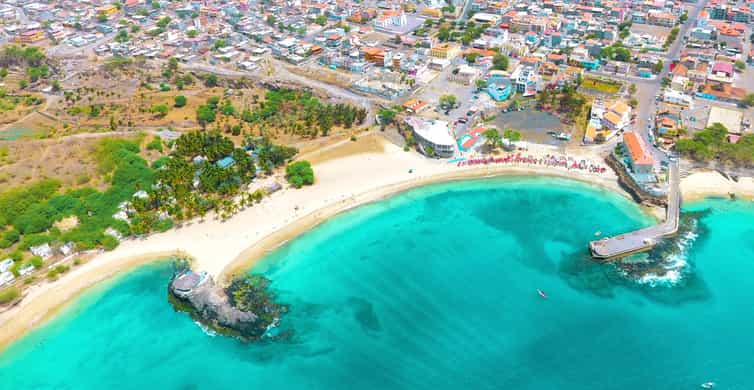
São Filipe, the island's capital, is one of the most attractive towns in the country: cobbled streets on a cliff above a black-sand beach, squares with gardens and colourful sobrados, the two-storey houses of the colonial merchant families. Several sobrados are now small hotels and guesthouses, and hotels on Fogo are all small and independent; there are no resorts. Draw escudos here before going up to Chã (currency and prices).
The biggest event of the year is the festival of Nhô São Filipe around 1 May, when extra flights are added and rooms fill up early. Do not expect beach days: Fogo's beaches are steep black sand with heavy surf and strong currents, so swim only in sheltered spots such as the natural rock pools at Salinas, and only when the sea is calm.
Getting to Fogo and getting around
Fogo has no international flights. CVsky, the state inter-island airline, flies from Praia to São Filipe aerodrome in about half an hour. The airport uses visual approaches, and the airline itself warns that dust haze and low cloud can delay or cancel flights there. By sea, CV Interilhas sails from Praia to Fogo in about four hours, several times a week, and the ships continue to Brava; sailings depend on the sea. Compare both in ferries and flights between the islands and see airports and transfers for arriving in Praia.
On the island, shared minibuses (aluguers) run from São Filipe up to Chã das Caldeiras, usually leaving around midday and taking about two hours with stops; they come back down early in the morning. A private taxi or a tour is quicker.
Allow at least three nights: one in São Filipe and two in Chã, so you can climb and still have a spare morning if the weather closes in. Add two nights for Brava. Because flights and ferries are often late, do not plan Fogo for the last days before your flight home. Views are often clearer outside the August-October wet season; see the best time to visit.